_RGB.png)

E-Mobility
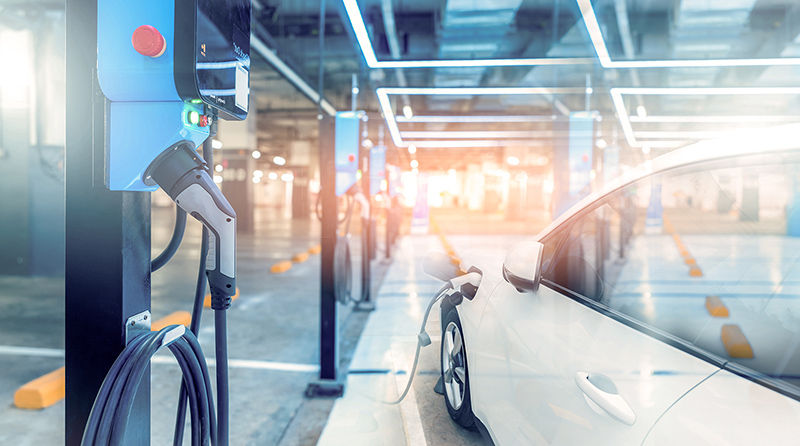
E-Mobility as a Pillar of Sustainable Airport Operations
Airports are under increasing pressure to reduce emissions from ground operations while maintaining high levels of reliability and safety. Ground support equipment, service vehicles and landside traffic contribute significantly to local emissions.
The transition to electric mobility is therefore a strategic priority for many airports. However, electrification requires coordinated planning of charging infrastructure, grid capacity, energy management and fleet replacement strategies.
E-mobility is not limited to replacing diesel vehicles with electric alternatives. It involves the integration of smart charging systems, load balancing technologies and long-term infrastructure planning.
GATE provides the platform for exchange between airports and its member companies. The technologies, engineering expertise and implementation strategies are delivered by member companies in cooperation with airport operators and energy partners.
What Are the Main E-Mobility Challenges for Airports?
Electrifying an airport is less about vehicles and more about everything around them. The challenges below describe where the harder questions sit, across charging, grid capacity and energy planning, and what helps to address them.
How Do GATE Members Address E-Mobility at Airports?
In practice, e-mobility at airports moves forward step by step, fleet by fleet. The projects on this page show how GATE member companies have addressed the challenges above at airports in Europe and other regions.
Electrifying Airport Ground Fleets: Colibri Energy's Lithium Technology at Abu Dhabi Airport
Electrifying airport ground support equipment requires technology that performs reliably under intensive, round-the-clock airport conditions. Colibri Energy's advanced lithium-ion battery systems deliver exactly this, as demonstrated at Abu Dhabi International Airport, where the airport joined six other Middle East hubs in converting its GSE baggage tractor fleet to Colibri's German lithium technology. Working with partners TCR and Charlatte, the deployment includes IP55-rated outdoor chargers built for ultra-fast charging in all climatic conditions – cutting emissions and operating costs while setting a benchmark for GSE electrification in one of the world's fastest-growing aviation markets.
GATE Member(s) involved in the project:

Emission-Free Apron: Vilnius Airport Goes All-Electric with COBUS
Starting in 2026, every passenger transfer between terminal and aircraft at Vilnius International Airport will happen in a fully electric bus. Lithuanian Airports has ordered 12 e.COBUS 2700 buses from COBUS Industries – a €7.2 million investment that will completely replace the existing diesel fleet. Built on a Mercedes-Benz chassis with Siemens ELFA drive technology and 282 kWh lithium-titanate batteries, these airport-specific electric buses are engineered for the demanding duty cycles of apron operations. The move supports Lithuania's national airports' goal of achieving CO₂ neutrality by 2030 and marks a decisive step toward emission-free ground transport at one of the Baltic region's fastest-growing airports.
GATE Member(s) involved in the project:

Engines Off from Gate to Runway: Trepel's Green Taxiing Solution at Schiphol
Every kilometre an aircraft taxis under its own power burns fuel and generates emissions that can be avoided. TREPEL's CHARGER 380e towbarless aircraft tractor makes this possible through the Aircraft Extended Towing Procedure (AETP): aircraft are towed with engines switched off all the way from the terminal gate to the runway threshold. Demonstrated in a real-world test with a KLM Boeing 787 at Amsterdam Airport Schiphol, the procedure saved up to 200 kg of jet fuel and avoided 600 kg of CO₂ per kilometre of taxiing. TREPEL's partnership with EcoTUG is turning a bold concept into an operational reality at one of Europe's premier aviation hubs.
GATE Member(s) involved in the project:

What Are the Main E-Mobility Challenges for Airports?
Electrifying an airport is less about vehicles and more about everything around them. The challenges below describe where the harder questions sit, across charging, grid capacity and energy planning, and what helps to address them.


